Reference
Start from a known article, a buyer swatch or a written construction: warp and weft, yarn count or tex where it matters, and the finish already approved.
Fabric selection desk
Compare home textile and upholstery constructions against one written brief before a mill quote is treated as comparable.
Send a fabric brief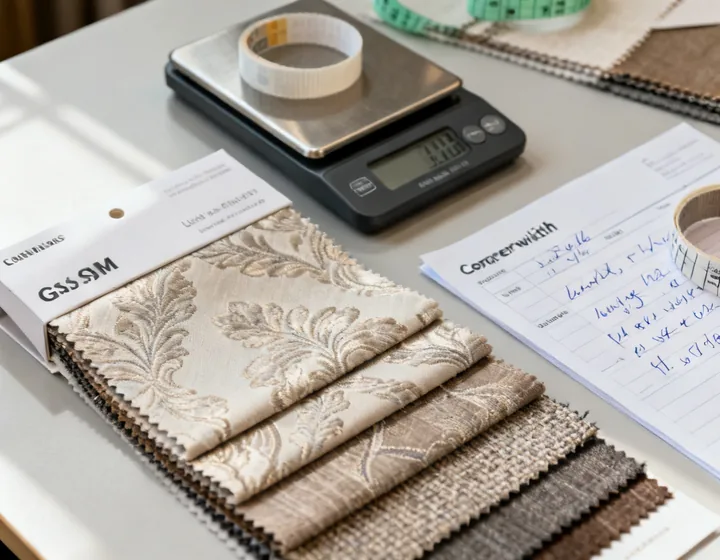
Romo coordinates supplier matching from China. The desk does not claim the original brand site, a mill, or an authorized distribution channel.
State fiber composition, woven or knitted construction, target GSM with tolerance, usable width, finish, pattern repeat, quantity and destination. A cotton jacquard fabric for curtains and a polyester jacquard fabric for seating can share a motif and still differ in float length, shrinkage and abrasion method. Record those differences before prices are lined up.
If the reference is a lab dip, say whether the approval covers ground color only or the full jacquard pattern. If it is a retained swatch, note the face, the date and any shade band already accepted.
These stages describe the record to keep. They are not a promised calendar.
Lock application, composition, construction, GSM, usable width and the unit of purchase. Open questions stay visible so a later sample is not treated as a silent change.
Ask each mill to answer the same width basis, finish list and packing unit. A metre price without usable width is not comparable with a price that already deducts selvedge.
Separate color approval from construction approval. A floral jacquard fabric can match a lab dip and still miss the agreed repeat or pile direction.
Name the inspection method, the retained reference and who accepts shade continuity. An approved hanging swatch does not by itself release every later roll.
The catalog on this desk stays inside home textile and upholstery fabrics. Listings are inquiry targets, not a claim that a named house collection is in stock.
Start from a known article, a buyer swatch or a written construction: warp and weft, yarn count or tex where it matters, and the finish already approved.
Comparable routes can include damask jacquard, brocade constructions, chenille jacquard and plain-ground jacquard for curtains or seating. Each option is quoted only after the same brief is sent.
A retained swatch sets appearance and handle. Bulk acceptance uses a separately agreed sampling plan, defect points and shade-band rule. Colorfastness, abrasion resistance and dimensional stability belong to a named method, a sample condition and a lot. Romo does not publish site-owned certificates, and a supplier document is not a credential of this desk.
| Use | Requirement to clarify |
|---|---|
| Drapery and jacquard curtain fabric | Usable width often written near 140-150 cm or 280 cm, a vertical repeat in centimetres, drape versus stiffness, and whether the finish is for dry cleaning or home washing. A light cloth brief may cite 150-200 gsm. |
| Upholstery and jacquard sofa fabric | Abrasion method such as ISO 12947, seam slippage, pattern join and the rub count the buyer actually requires. Seating briefs often start around 280-400 gsm and must still state tolerance. |
| Decorative cushion and bedding cloth | Fiber content, pilling, shrinkage and whether the face is cotton jacquard, polyester jacquard or a blend. Repeat and usable width decide yield; a 32 cm vertical repeat is a briefing example, not a stock item. |
Name the lab dip, strike-off or retained swatch, including ground color and motif. A white jacquard fabric and a cream jacquard fabric can fail a shade check even when the weave drawing is unchanged. Confirm the light source and the viewer only if the buyer program requires them.
Align currency, Incoterm, price per metre or per kilogram, net versus gross width, MOQ and whether the repeat waste is inside the price. Stock cloth may shorten development, while a custom jacquard fabric may need a new card or file and a mill-specific minimum. Neither route has a universal lead time on this site.
The buyer names the method and the lot. The selected supplier or an agreed laboratory runs the test. Romo can coordinate the request and the document handoff. Four-point inspection, when used, needs a written point limit and a rule for short rolls.
Before the RFQ